Bat removal is carpentry, with a calendar.
The permanent fix is not poison, and it is not traps. It is exclusion: one-way valves that let the colony fly out at dusk and cannot let it back in, then a sealed roofline, scheduled around the season when flightless pups are inside.
The 2-minute requestA personal reply within 2 business days
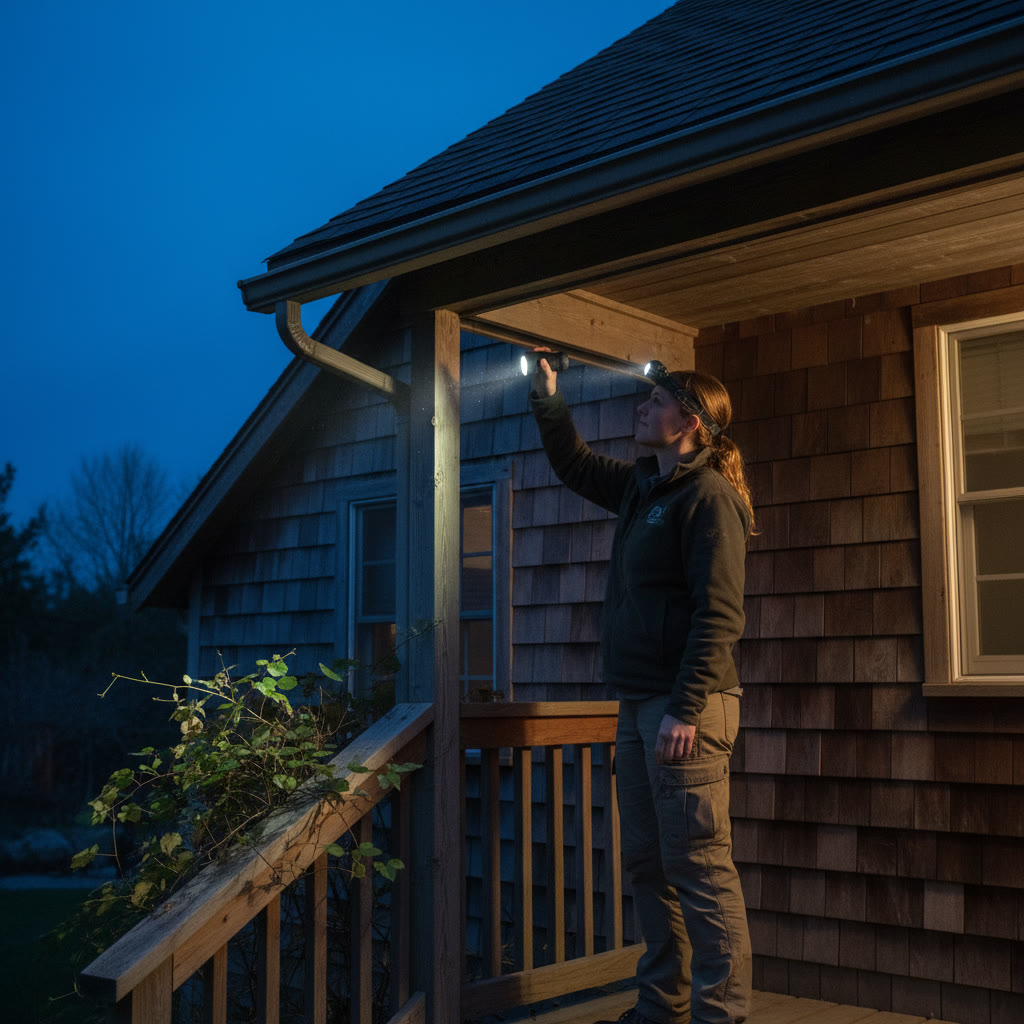
- 1Inspect: every gap from ridge cap to sill
- 2Time: the legal window, checked first
- 3Exclude and seal: valves out, carpentry shut
Nobody is exterminating anything. The real work is carpentry.
Bats are protected in most states, several species are federally listed, and no pesticide is registered for use on them anywhere in the United States. So the entire legitimate industry does the same three things: find every entry point, check the calendar, and let the colony exclude itself through one-way valves before the house gets sealed. The companies worth hiring are the ones honest about that.
The 3/8-inch audit
A bat needs a gap about the width of a pencil. Ridge caps, gable vents, chimney flashing, soffit returns, fascia boards: the inspection maps every one, plus the stained, smudged holes actually in use.
The legal calendar
From roughly May to August in much of the country, flightless pups are inside and many states restrict exclusion. The real window is set by your state wildlife agency, so we check it before anyone climbs a ladder.
Valves out, house shut
One-way valves go over the active exits, the colony leaves at dusk to feed and cannot get back in, and after several nights the carpentry closes every gap for good. Sealing is the product. Everything else is preparation.
Where they actually get in.
- 1Ridge cap ends. The peak of the roof, where cap meets shingle. Warm air pours out here, which is exactly how bats find it.
- 2Gable vents. Louvered vents with torn or missing screen are a bat door. Staining and droppings below give an active one away.
- 3Chimney flashing. The joint where masonry meets roofline opens as houses settle. Also the raccoon and squirrel highway.
- 4Soffit returns and eave gaps. Sealed with caulk, foam backer, and metal flashing that matches the house, not wads of spray foam.
- 5Fascia and trim lines. Screened and closed with hardware cloth where ventilation must keep working. The house still has to breathe.
- 6The maternity window. Typically May into August, set state by state. Exclusion waits for it, and the good operators say so up front.
One bat, a whole colony, or a smell in the wall.
Different problems, different urgency, same principles. Here is what each one actually involves, so you can hear a quote and know what is being priced.
A single bat in a living space is a health question before a wildlife question. If anyone may have had contact, or it was in a room with someone sleeping, call your local health department before releasing it. Then find how it got in.
- ✓ Contain it in one room, lights on, door shut
- ✓ No bare-handed handling, ever
- ✓ One bat often means a roost nearby, so inspect
Scratching at dusk, droppings under a gable, staining at a gap: that is a roost. The fix is the full sequence, inspection, timing check, one-way valves, then sealing the whole envelope, with cleanup priced honestly on top.
- ✓ Every entry mapped, not just the obvious one
- ✓ Valves stay up several nights of fair weather
- ✓ Sealing and screening are the deliverable
The smell peaks, the flies tell the truth, and the fix is surgical: find the cavity, open it small, remove and sanitize, then close the entry the animal used. Skip that last step and the wall gets used again.
- 01 Locate by smell, flies, and inspection camera
- 02 Open a small, patchable access
- 03 Remove and treat with enzymatic cleaner
- 04 Patch the wall
- 05 Seal the entry point that started it
Whatever the job, same promise. One request, one vetted operator, or an honest “not yet.”
The evening sky is the point.
The same animals you want out of your attic spend every night eating insects over your neighborhood, which is a big part of why the law protects them. The job was never to destroy the colony. It is to move it from your framing to the sky, and to seal the house so the arrangement stays permanent.
What each season actually allows.
Timing is the part of this trade that surprises homeowners most, so here it is plainly. Dates vary by state and species; your state wildlife agency owns the real window, and our free checker links you straight to it.
No lead auctions
Most "find a pro" sites sell your phone number to whoever pays, then four companies call you during dinner. Your request here goes to one vetted operator, or to nobody until we have one worth sending.
No extermination theater
No pesticide is registered for use on bats in the United States, so "spray for bats" is not a service, it is a violation. We will never connect you with anyone who offers one, and we name the honest fix instead: exclusion and carpentry.
If the calendar says wait, we say wait.
We will not schedule an exclusion that strands flightless pups in your walls, even when a competitor will. What you get in the meantime is real: the single-bat emergency handled, the full entry map, the cleanup plan, a written quote, and the first legal date on the books.
A free exclusion plan for your house.
- ✓ An honest read on what you are hearing, smelling, or finding, and what animal it points to
- ✓ The entry-point map for your kind of house, ridge cap to sill plate
- ✓ The typical exclusion timing for your region, plus the state agency that sets the real window
- ✓ An introduction to a vetted local wildlife control operator as coverage opens in your area
The 2-minute requestA personal reply within 2 business days
A vetted network, built carefully
We are building our network of local wildlife control operators right now, and we only pass your request to an operator we have actually vetted on licensing, exclusion practice, and how they treat protected species. If we do not have one near you yet, we say so plainly, and we send you the checklist we use so you can vet a local company yourself.
Built for the week the scratching started.
Timing before ladders
The first question is what the calendar allows in your state, not how fast someone can invoice you. It is the question that keeps the fix legal and permanent, and the one a boiler-room operation never asks.
Vetted, or we say not yet
We qualify operators on licensing, insurance, exclusion practice, and how they treat protected species before we introduce anyone. No vetted operator near you? We say exactly that.
Free means free
Homeowners never pay us. If an operator we introduce gets hired, they may pay us a referral fee. It never changes your price, and we disclose it right here rather than in a footnote.
BatCleared is new, so we do not show customer reviews yet. The cards above describe how we work, not testimonials, and we will never invent one. Questions about bat contact, rabies, or droppings and health belong with your doctor, your local health department, and the CDC.
Questions homeowners actually ask.
Why can't I just seal the holes tonight?
Because the bats are still inside. Seal at the wrong moment and you trap the colony in your walls, where the animals die, the smell starts, and the health risk goes up, or you seal while mothers are out feeding and their flightless pups starve inside. Both outcomes are worse than the problem you started with, and trapping bats inside a sealed structure can violate state wildlife protections. The professional sequence is the opposite: install one-way exclusion valves over the active exits so bats leave on their own at dusk and cannot re-enter, wait several nights of decent weather, and only then seal everything permanently.
Is it legal to kill the bats in my attic?
In most of the United States, no, and it is a genuinely bad idea even where enforcement is thin. Bats are protected under state law in most states, and several species, including the Indiana bat, the gray bat, and the northern long-eared bat, are federally protected under the Endangered Species Act. On top of that, no pesticide is registered for use against bats in the United States, so any poison application aimed at bats is illegal pesticide misuse, and it tends to scatter sick animals into your living space. The legal, permanent fix is exclusion. Check your state wildlife agency for the exact rules where you live, and the U.S. Fish and Wildlife Service at fws.gov for federally listed species.
What is maternity season, and why does it stop the work?
Female bats gather in warm attics in late spring to give birth, typically one pup each, and the pups cannot fly for several weeks. During that stretch, commonly somewhere between May and August in much of the country, excluding the adults would leave flightless young trapped inside to die. That is why many states restrict or prohibit attic exclusions during a defined maternity window. The dates vary by state and by species, so treat any dates you read online, including ours, as typical, and confirm the real window with your state wildlife agency before scheduling work. Our free exclusion season checker shows the typical window for your region and links you to the agency that owns the answer.
What does bat removal actually cost?
As typical published planning ranges, not quotes: getting a single bat out of a living space often runs one to a few hundred dollars. A full attic exclusion, which is really an inspection plus one-way valves plus sealing every gap on the house, commonly lands somewhere between $1,500 and $5,000 depending on the size and complexity of the roofline. Large colonies, tall or complex houses, and significant guano cleanup push higher, sometimes well past that. Droppings remediation and insulation replacement are usually priced separately. Your house sets the real number, which is why the honest first step is an inspection, not a phone quote.
Something died in my wall. What will a pro actually do?
Locate, remove, sanitize, and then close the road in. A technician narrows the location by smell concentration, fly activity, and sometimes an inspection camera, then either retrieves the carcass through an existing opening or cuts a small access hole in the drywall, removes the animal, treats the cavity with an enzymatic cleaner, and patches or leaves the patch to a drywall repair, depending on the company. The part homeowners skip is the last one: figuring out how the animal got in and sealing that route, because an open entry point turns one bad week into a recurring one.
Is bat guano actually dangerous?
It can be, and the honest version has a name: histoplasmosis, a lung infection caused by a fungus that can grow in soil and droppings where bat or bird waste accumulates, especially in parts of the central and eastern United States. Most exposures cause no or mild symptoms, but large, disturbed accumulations in enclosed attics are exactly the wrong thing to dry-sweep or vacuum with household gear. The CDC and NIOSH publish specific guidance: keep the material damp, use proper respiratory protection, and let trained crews handle significant cleanups. Read our attic cleanup guide, and see cdc.gov for the underlying health guidance.
I woke up and there was a bat in my bedroom. What now?
Treat that one as a health question first and a wildlife question second. Because bat bites can be small enough to miss, the CDC advises that direct contact with a bat, or waking to find a bat in the room with a sleeping person, is a situation to take seriously: if you can do it without touching the bat bare-handed, contain it in the room rather than releasing it outside, and call your local health department promptly. They will tell you whether the bat should be captured and tested for rabies and whether post-exposure care makes sense in your case. Rabies is rare in humans in the United States, but most recent U.S. cases have been linked to bats, which is why the guidance is careful. Health first, then call us about how it got in.
What does BatCleared charge?
Nothing, to you. The exclusion plan is free, and there is no obligation attached to it. If we introduce you to a wildlife control operator and you hire them, that operator may pay us a referral fee, which is how services like ours are typically funded. That fee never changes your price, and we tell you plainly when we have no vetted operator near you rather than selling your request to whoever will pay for it.
Three tools that do the homework for you.
Exclusion Season Checker
Pick your region and month, see whether you are likely inside the typical maternity window, and get the state agency that owns the real answer.
Removal Cost Estimator
Bats, a dead animal, or full exclusion and cleanup: the typical published range for your kind of job, before anyone quotes you.
Entry Point Checklist
Walk your own house with the same list an inspector uses, gable vents to sill plates, and leave with a count of what needs sealing.
Out at dusk, sealed for good.
Tell us what you are hearing, smelling, or finding. We will map the entries, check the calendar for your state, and connect you with a vetted local operator as coverage opens in your area.
Get your free exclusion planThe 2-minute requestA personal reply within 2 business days
And the promise holds: one request, one vetted operator, or an honest “not yet.”
Every request is read and answered by a person, not a queue.